
Modern vehicles rely on cameras, radar, and other sensors to track lanes, traffic, and nearby hazards. When one of those components is moved during a repair, the system can still turn on while reading the road incorrectly. Calibration addresses that gap. Average ADAS calibration fees have doubled in recent years, reflecting how common and necessary this step has become in vehicle repair.
After replacing your windshield, it is essential to schedule professional ADAS Calibration to restore the accuracy of features like lane departure warning, adaptive cruise control, and automatic emergency braking. These advanced systems depend on precise sensor positioning, and even a small deviation can cause the system to misinterpret distance, speed, or object placement.
There are different types of ADAS calibration, each designed to restore sensor accuracy in specific conditions and for different systems. In this blog, we break down the difference between static and dynamic calibration, how each one works, and when each is required after a repair.
What is ADAS Calibration?
ADAS sensor calibration restores the accuracy of safety features such as lane departure warning, adaptive cruise control, blind spot monitoring, and automatic emergency braking. These systems depend on precise sensor positioning. Even a small deviation can cause the system to misread distance, speed, or object placement.
Canadian driving conditions add another layer to this. Potholes, uneven roads, and seasonal wear can alter alignment enough to affect sensor direction. A vehicle may continue operating without warning, even when readings are off. ADAS calibration after auto glass replacement is typically treated as part of completing the repair rather than a separate add-on.
What is Static Calibration?
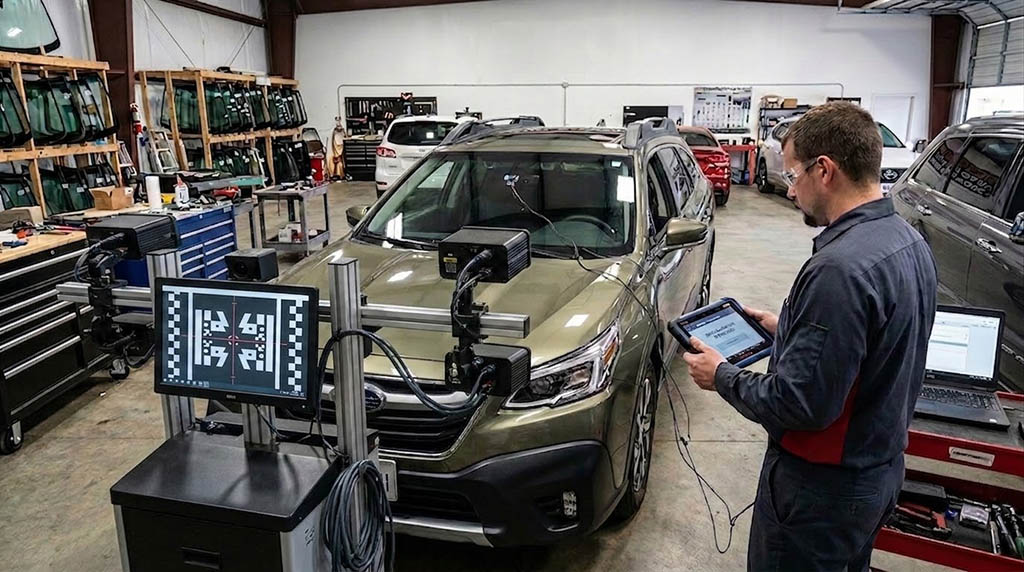
It is a controlled procedure performed indoors with the vehicle kept stationary. Technicians place calibration targets at exact distances and heights, then activate calibration mode through a scan tool. The system reads those fixed reference points and adjusts accordingly.
Static calibration works well when accuracy must be established without outside interference. Weather, traffic, and lighting do not factor into the process.
Several conditions support accurate results:
- A level floor so angles remain consistent
- Even lighting without glare or shadow
- Adequate space for target positioning
- Minimal reflective surfaces near radar sensors
- Exact adherence to manufacturer specifications
Each factor influences the outcome. Skipping one detail can lead to inaccurate readings after the calibration is complete.
What is Dynamic Calibration?
It takes place while the vehicle is driven on public roads. Instead of relying on targets, the system uses lane markings, traffic movement, and road features to fine-tune sensor alignment. A technician begins the process, then the vehicle completes a required drive cycle.
Transport Canada notes that driver assistance technologies rely on accurate sensor input to support safe vehicle operation.1
External conditions play a major role here. Road markings must be visible. Traffic needs to allow consistent tracking. The weather has to cooperate. Heavy rain, snow, or fog can interrupt or delay calibration.
For dynamic calibration to complete properly, several factors come into play:
- Clear lane markings that the system can follow
- Stable traffic flow with enough spacing between vehicles
- Suitable weather without visual or signal interference
- Specific speed and distance requirements based on the vehicle
These conditions can be difficult to maintain in Canadian climates. Salt residue, worn paint lines, and winter driving conditions often interfere with calibration accuracy.
Static Vs Dynamic Calibration
Comparing static vs dynamic calibration comes down to how the system is aligned and verified. One method relies on a controlled indoor setup. The other depends on real-world driving conditions.
Both methods serve a purpose. The correct option depends on the vehicle, the sensor, and the manufacturer’s instructions. Some systems require one method. Others require both.
| Aspect | Static Calibration | Dynamic Calibration |
| Environment | Indoor service bay | Public roads |
| Reference Point | Fixed targets and measurements | Lane markings and traffic conditions |
| Strength | Controlled accuracy | Real-world validation |
| Limitation | Requires space and equipment | Dependent on weather and road quality |
| Canadian Conditions | Reliable year-round | Limited during winter and poor visibility |
Many vehicles now use a hybrid process. Calibration begins indoors to establish baseline alignment, then continues on the road to confirm system performance in motion.
ADAS Camera Calibration And Measurement Accuracy
Small errors in sensor positioning can affect how the system calculates distance, speed, and object location. A slight angle change near the vehicle can lead to larger tracking errors further ahead.
A system can remain active without displaying faults while still providing inaccurate data. This creates a risk where drivers rely on features that are no longer functioning correctly.
Errors increase over distance. A minor deviation at the sensor level becomes more significant as the system tracks objects farther down the road. That is why calibration follows exact specifications rather than approximation.
How Long Does Calibration Take?
Timing varies based on the method and the vehicle. Static calibration includes setup, measurements, and system adjustments. Dynamic calibration depends on completing the required drive cycle under the right conditions.
According to NHTSA, driver assistance systems are designed to support the driver and do not replace the need for full driver attention.2
Some vehicles require only one system to be calibrated. Others involve multiple sensors, which increases the time needed. Delays can also occur when weather or road conditions prevent a proper dynamic drive cycle.
Documentation often accompanies the process. After repairs involving glass, suspension, or alignment, ADAS calibration records confirm that the system has been restored to its intended function.
Final Thoughts
Static and dynamic calibration both contribute to how driver assistance systems function on the road. One establishes alignment in a controlled setting. The other confirms performance during actual driving conditions.
When completed correctly, an ADAS sensor calibration allows the system to interpret its surroundings as intended. Skipping steps or completing the process incorrectly can leave the system active but inaccurate. That can affect braking response, warnings, and tracking without clear signs to the driver.
Reference
- Canada, Transport. “Canada’s Safety Framework for Connected and Automated Vehicles 2.0.” Transport Canada, 11 Feb. 2025, tc.canada.ca/en/road-transportation/innovative-technologies/connected-automated-vehicles/canada-s-safety-framework-connected-automated-vehicles-20.
- “Driver Assistance Technologies | NHTSA.” NHTSA, www.nhtsa.gov/vehicle-safety/driver-assistance-technologies.